
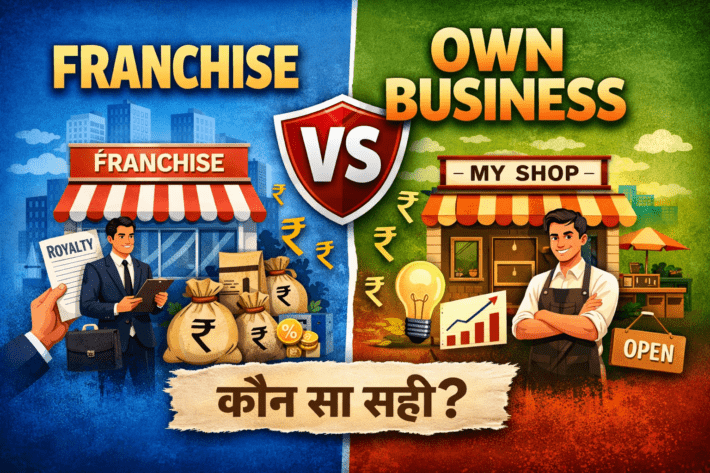
The Brutal Truth Every First-Time Investor in India Must Hear Before Putting In a Single Rupee
The Question That Keeps 10 Lakh Indians Up at Night
Every week, someone calls me with the same question in different words.(Franchise vs Own Business)
“Sir, mere paas Rs. 10 lakh hain. Should I start my own business — ya koi franchise le loon?”
This single question — franchise business vs own business — is the most important financial decision many middle-class Indians will ever make. And most people make it based on gut feeling, a friend’s opinion, or a flashy YouTube ad. Not facts. Not numbers. Not ground reality.
| Business mein emotion nahi, calculation hoti hai. Aur aaj hum wahi calculation karenge — together. |
I have been working as a franchise consultant across India for years. I have sat across the table from retired government employees in Patna, young engineers in Indore, homemakers in Surat — all asking the same thing. And I have seen both paths lead to success and to painful losses.
So today, no sugarcoating. Just the honest, ground-level truth that will help you make the right call for your money, your city, and your situation.
First, Let’s Kill One Big Myth About Both Options
People in India have two very common illusions when it comes to business.
Illusion 1: “Apna business matlab full freedom. Main apne boss hoon.” Yes — and also full risk, full struggle, full learning from scratch. That freedom comes at a very real cost.
Illusion 2: “Franchise lene se business automatic chalega.” Absolutely not. A franchise gives you a proven system — not a self-running ATM. You still have to show up, manage, and execute every single day.
| The truth about franchise business vs own business is this: neither path is easy. The question is which type of difficulty you are better prepared to handle. |
Now let us look at what both options actually look like on the ground — with real numbers.
Franchise Business vs Own Business: The Honest Head-to-Head
Here is a side-by-side comparison of what you are actually signing up for with each path. No marketing language. Just ground reality kya hai:
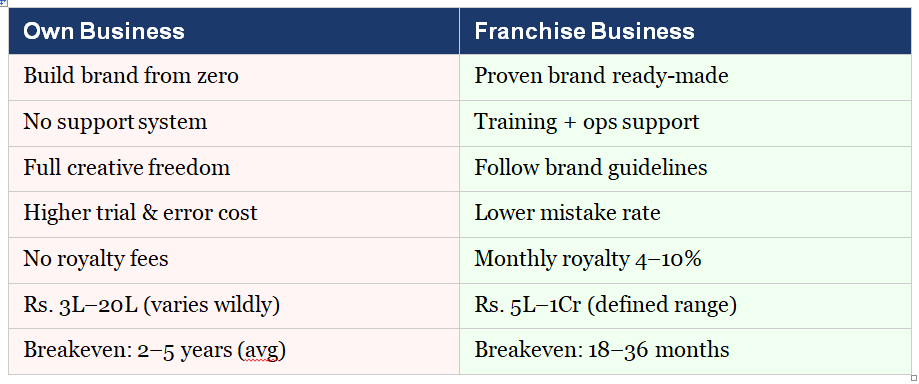
What These Numbers Mean for a First-Time Investor
If you are starting your first business in India — especially in a Tier 2 or Tier 3 city — these differences are not small. They are life-changing.
When you start your own business, you are paying for every mistake with your own money. Product development, branding, customer acquisition, pricing strategy, supply chain — you figure all of this out as you go. Some people thrive on that challenge. Most first-timers do not.
With a franchise business, that learning curve has already been paid for — by the brand, over years of trial and error. You are essentially buying the answer key before the exam.
But here is the critical catch: you are also bound by that answer key. You cannot change the menu, rebrand the store, or pivot the business model. If the brand’s system has flaws, you inherit those too.
Let’s Talk Real Money — Because Rs. 10 Lakh Means Different Things in Different Paths
Own Business: What Rs. 10 Lakh Actually Gets You
Let us say you want to open a small clothing store in Lucknow. You have Rs. 10 lakh.
- Shop rent deposit + first 3 months rent: Rs. 1.5 lakh
- Interior setup and storage: Rs. 1.5 lakh
- Initial inventory: Rs. 4 lakh
- Staff salary for 3 months: Rs. 90,000
- Signage, branding, social media, marketing: Rs. 80,000
- Working capital buffer: Rs. 1.3 lakh
Total outflow: Rs. 10 lakh. And you start with zero customers, zero brand trust, and zero proven demand. You are betting that your product selection, your location, and your marketing will work. Some do. Many struggle for 12 to 24 months before finding their footing.
Franchise Business: What Rs. 10 Lakh Gets You
With Rs. 10 lakh in a solid growing-brand franchise in a service or food category, you could be looking at:
- Franchise fee to a growing mid-market brand: Rs. 3 to 4 lakh
- Setup and fit-out support from the brand: Rs. 3 lakh
- Initial stock or raw material (brand-guided): Rs. 1.5 lakh
- Training, onboarding, operational setup: Included
- Working capital buffer for 3 months: Rs. 1.5 lakh
The critical difference here is that you start with a brand that people already recognise and trust. Your day one is not ground zero — it is a head start.
| Apna business mein Rs. 10 lakh ka matlab hai — aap experiment kar rahe ho. Franchise mein Rs. 10 lakh ka matlab hai — aap ek proven model ko execute kar rahe ho. |
Real Story: Arjun vs Priya — Same City, Same Budget, Very Different Outcomes
Arjun Tiwari and Priya Sharma both live in Indore. Both had Rs. 12 lakh saved up in 2022. Both wanted to start a business. They made different choices.
Arjun’s Story: Own Business
Arjun decided to open his own quick-service food counter. He was passionate about food, had a few home-recipe ideas, and felt confident. He spent 6 months designing the brand, setting up the kitchen, and building a small social media following.
By month 8, he was struggling. The product was good, but footfall was inconsistent. He had underestimated marketing costs. By month 14, he had spent Rs. 15 lakh — Rs. 3 lakh more than planned — and was just about breaking even. Today, 2.5 years in, Arjun is profitable. But the journey cost him savings, stress, and a year of uncertainty he was not fully prepared for.
Arjun will tell you himself: “Kash maine pehle business mein thoda aur research kar li hoti.”
Priya’s Story: Franchise Business
Priya went a different route. She researched a growing educational services franchise with 80 active outlets in Tier 2 cities. She asked hard questions, verified franchisee profitability, and spoke to 5 existing franchise owners before deciding. She invested Rs. 11 lakh total.
By month 6, she was covering her operating costs. By month 18, she had recovered her investment. By month 24, she was looking at opening a second outlet in Bhopal.
What was Priya’s advantage? She did not waste time or money building something from scratch. She stepped into a working system with a real support team behind her.
| Arjun is not a failure. He made a brave choice and it eventually worked. But Priya made a calculated choice — and that made all the difference in speed, stress, and money. |
So — When Should You Actually Choose Each Path?
Choose Own Business If…
- You have a very specific product or skill that is genuinely unique and has clear market demand in your city
- You can afford 2 to 4 years of relatively low income while you build — financially and emotionally
- You have prior business experience or a strong mentor network
- You want full creative control and are willing to pay the price for it
- You have already validated your idea with real customer feedback — not just family opinions
Choose Franchise Business If…
- This is your first venture into business, and you want a structured, lower-risk starting point
- You have capital in the Rs. 5 lakhs to Rs. 25 lakh range and want predictable ROI timelines
- You are in a Tier 2 or Tier 3 city where brand recognition brings customers faster than a new name
- You can execute well but do not want to spend years building systems from scratch
- You want to be in business in 60 to 90 days, not 12 months
The Consultant’s Checklist: 5 Hard Questions Before You Commit to Either Path
Whether you go down the franchise business vs own business route — these five questions will protect your money. Do not skip even one.
- Is there real, verified demand for this product or brand in my specific city? (Not just in metros — in my city, my street, my customer base.)
- Have I stress-tested my financial projections at 30% lower revenue? If the numbers still work at reduced income, the model is sound. If they do not — rethink.
- Have I spoken to at least 4 or 5 people who have already done this — not family, not friends, not the seller — but real operators on the ground?
- Do I have 6 to 9 months of working capital set aside beyond my investment? Starting a business without a financial buffer is not courage — it is avoidable risk.
- Am I choosing this because the numbers make sense — or because I am excited? Excitement fades. Lease agreements do not.
Frequently Asked Questions
Q1. Is franchise business vs own business always an either-or decision?
Not necessarily. Some smart investors start with a franchise to learn the fundamentals of running a business — cash flow, customer management, operations — and then launch their own brand with that experience behind them. The two paths are not enemies. They can be stages.
Q2. Which option is better for someone with no business background?
For a first-time investor with no prior experience, a well-researched franchise business is almost always the safer starting point. You get a proven system, operational support, and a much shorter learning curve. The key word is well-researched — a bad franchise is worse than a good own business.
Q3. Can I start a franchise business in a small town or Tier 3 city?
Yes — and increasingly, this is where the best opportunities are. National brands are actively looking to expand in Tier 2 and Tier 3 cities. If you find a brand with genuine product-market fit in your area, a smaller city can mean lower rent, less competition, and faster ROI than a crowded metro location.
Q4. How do I know if a franchise is worth the fee they are asking?
Simple test: Ask them how many of their existing outlets are actually profitable — not just open, but profitable. Ask for franchisee contacts and call them independently. Ask to see real monthly P&L data from an existing outlet. If they hesitate on any of these — that hesitation is your answer.
Q5. What is the biggest mistake people make in this franchise business vs own business decision?
Making it emotionally instead of analytically. Most people who lose money on franchise deals were sold on the dream of easy income. Most people who struggle in their own business underestimated time, cost, and competition. The solution in both cases is the same: research first, commit second.
Franchise Business vs Own Business: The Final Word
Let me say this clearly one more time, because this is the point that matters most.
Neither franchise business nor own business is guaranteed. Both can succeed. Both can fail. The difference is always in the preparation — how much research you did, how honestly you stress-tested your numbers, and how clearly you understood what you were signing up for.
Franchise business vs own business is not a battle with a universal winner. It is a personal decision that depends on your capital, your risk tolerance, your city, your skills, and your patience.
What I can tell you from years of ground experience is this: the investors I have seen succeed — in both categories — are the ones who walked in with their eyes open, not their hearts racing.
| Gold mine aur trap ke beech ka fark sirf ek cheez hai — kitna socha, kitna research kiya, aur kitna honestly khud se poocha: kya main is business ke liye actually ready hoon? |
Take the First Smart Step — Right Now.
If you are serious about starting a business — franchise or your own — and want an honest, independent assessment of what makes sense for your budget and your city, here is what to do next.
Watch the full video on YouTube (link: https://www.youtube.com/watch?v=Ke3W5cF2G9Q) for a complete ground-level breakdown of this topic.
Then comment “FRANCHISE” on the YouTube video — and I will send you a Free Budget Assessment Tool that shows you exactly which business model and investment level is right for your capital.
Share this article with someone in your family or friend circle who is sitting on the fence about starting a business. One honest conversation now is worth more than one year of regret later.
FranchiseZing.com | Based on YouTube: youtube.com/watch?v=Ke3W5cF2G9Q | Original content. No brand promotions. No affiliate fees. Just the truth.