
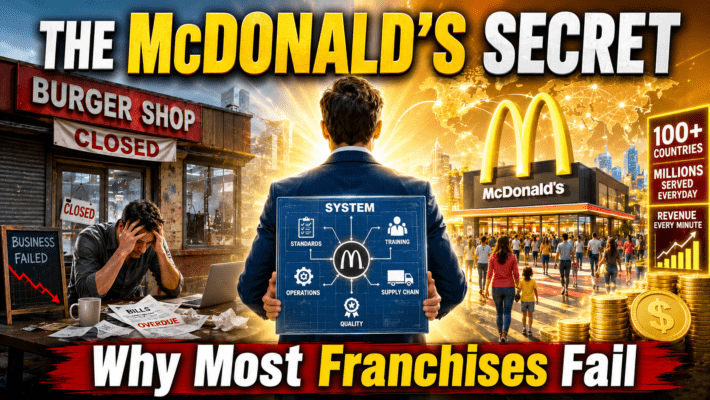
The McDonald’s Secret: 3 Lessons That Explain Why Most Franchises Fail
Every day, thousands of food shops open around the world — and most close within months. McDonald’s runs in 100+ countries and earns crores every minute. The difference is not the burger. The difference is the system.
Think about this for a moment. Every single day, thousands of burger shops, snack stalls, and fast food outlets open across the world. Most of them shut down within a few months. They had good food. Some had great locations. Many had passionate owners.
And then there is McDonald’s. Operating in 100+ countries. Serving millions of customers every single day. Generating crores of rupees every minute — whether the owner is present or not.
The question is not “what does McDonald’s sell?” Everyone knows it sells burgers. The real question is: how did McDonald’s build a system where failure became the exception, not the rule?
As someone who has spent 16 years guiding franchise investors across India — especially in Tier 2 and Tier 3 cities — I can tell you this: the McDonald’s franchise success system contains three lessons that every investor must understand before putting a single rupee into any franchise business. Let us decode them one by one.
▶ Watch Full Franchise Legends Breakdown by Gulshan Mishra
Watch the full video above — then read the complete breakdown below.
Lesson 1: McDonald’s Was Never in the Burger Business
Here is the biggest myth that most people believe: McDonald’s is a burger company.
Wrong. McDonald’s is a systems company that happens to sell burgers.
When the McDonald brothers — Richard and Maurice McDonald — first started, they did something nobody had done before. They turned their kitchen into a factory. Every single task was measured. Every burger was made to an identical size and weight. Every second of the cooking process was optimised. The fries were cut to the same length. The packaging was standardised.
This was not just food. This was process engineering. They called it the “Speedee Service System” — and it meant that any employee, anywhere, on any day, could produce the exact same burger in the exact same time.
What This Means for Indian Franchise Investors
Look at most franchise businesses that fail in India — especially in cities like Nagpur, Lucknow, or Bhopal. The owner is present every day, making all the decisions, handling every customer complaint personally. The moment he or she is not there, the quality drops. Sales fall. Staff gets confused.
That is not a franchise. That is self-employment with a branded logo.
Before investing in any franchise, ask this one question: “Can this outlet run for one full week without the owner being present?” If the answer is no — walk away. The system is broken. Visit FranchiseZing.com to learn how to evaluate a franchise system properly before you invest.
Lesson 2: Ray Kroc Did Not Invent the Burger — He Invented Discipline
Ray Kroc was a milkshake machine salesman when he first visited a McDonald’s outlet in 1954. He did not create the burger. He did not create the kitchen system. What Ray Kroc created was something far more powerful — replicable discipline.
When Kroc started expanding McDonald’s into a franchise empire, his obsession was one single thing: every outlet must deliver the same experience. Same quality of food. Same speed of service. Same cleanliness. Same smile from the staff. Whether you walked into a McDonald’s in Mumbai or Manchester — the trust had to be identical.
He created training manuals. He built Hamburger University — a literal training school for franchise operators. He personally visited outlets unannounced to check standards. He understood that one bad outlet could damage the trust that 10,000 good outlets had built.
The “Trust Scale” Problem in Indian Franchises
This is exactly where many Indian franchise brands fall apart. The founder opens 3–4 outlets. They are great — because the founder is personally managing them. Then they start selling franchises. Each new franchise owner runs their outlet slightly differently. One cuts ingredient costs. Another changes the menu. A third has poor hygiene.
Within 2 years, customers cannot predict what experience they will get. Trust is broken. The brand collapses — even though the original idea was brilliant.
Visit at least 3 existing outlets of any franchise brand you are considering — in different cities if possible. Eat the food. Check the cleanliness. Time the service. If each outlet feels noticeably different from the others, the brand has no real system. It only has a logo. That is not a franchise worth your money.
Lesson 3: McDonald’s Real Power Was Not Burgers — It Was Real Estate
This is the most shocking lesson of the three — and the one that almost nobody talks about.
McDonald’s biggest asset is not its food. It is its property.
Ray Kroc figured out something brilliantly simple. If you control the location, you control the franchisee. So instead of just licensing the brand, McDonald’s started buying or taking long-term leases on prime commercial properties — and then subletting those properties to franchisees at a rent that included a margin for McDonald’s.
This meant McDonald’s earned money in two ways from every single outlet: (1) A percentage of food sales as royalty. (2) Monthly rent from the same franchisee. Even if food sales were slow on a particular month, the rent cheque still arrived.
Today, McDonald’s is technically one of the largest real estate companies in the world — not just a fast food chain. The property business is what makes the entire model almost recession-proof.
What This Teaches Indian Franchise Investors
Most franchise investors in India focus entirely on the product and the brand name when choosing a franchise. They almost never ask the most important financial question: “What is the unit economics of this specific location?”
A franchise that works brilliantly in a high-traffic mall in Pune may completely fail in a standalone shop in a residential area of Jabalpur. The brand is the same. The product is the same. But the location economics are completely different.
Ask the brand for real P&L (profit and loss) data from at least 5 existing outlets — specifically ones in cities similar to yours. If a brand cannot show you real outlet-level financial data, they are asking you to invest blind. No credible franchise brand should hide this information from a serious investor.
Not sure how to analyse a franchise’s unit economics for your city? The team at FranchiseZing.com offers a free assessment that breaks down exactly what the numbers look like for your budget and location.
Indian Reality: Two Investors, Same Brand, Different Results — Indore
Investor A — Anil Sharma, 42, opened a popular snack franchise outlet in a busy market area of Indore. Before investing, he visited 4 existing outlets, checked staff training manuals, and confirmed the brand had standardised recipes with no owner discretion. He chose a location next to a college with high daily footfall. Break-even in Month 5. Profitable for 2+ years.
Investor B — Deepak Yadav, 38, opened the same franchise brand in a quieter residential lane of the same city. He chose the location because rent was cheap. He did not visit existing outlets. He assumed “same brand = same results.” Monthly sales were 40% below projections. Outlet closed in Month 8.
Same brand. Same city. Same products. Completely different outcomes — because of system understanding and location economics.
The McDonald’s Franchise Success Checklist — Apply to Any Brand in India
Before investing in any franchise, ask these five questions. They come directly from the McDonald’s success system:
- Can this outlet run without the owner for one full week? If no standard operating procedures exist, the business depends entirely on individuals — not systems. That is fragile and unscalable.
- Are quality standards measurable and written down? Visit 3 different outlets. The food, service speed, and cleanliness should be nearly identical. If each outlet feels different, standards are not being enforced.
- Does the brand provide real outlet-level financial data — not projections? Ask for actual P&L statements from existing franchisees in Tier 2 cities like yours. Refuse to accept only glossy brochure projections.
- What is the unit economics at your specific location? Calculate rent as a percentage of projected sales. If rent alone exceeds 20% of expected monthly revenue, the location economics may not support profitability.
- Has the brand grown systematically — or just fast? Rapid expansion without standardisation is a warning sign. Ask how many outlets closed in the past 2 years. A brand that cannot answer this is hiding something.
FAQ: McDonald’s Franchise Lessons for Indian Investors
Can I actually apply McDonald’s system principles to a small franchise in India?
Absolutely. The principles — systems over products, trust through consistency, and location economics — apply to any franchise at any scale. A tea franchise in Kanpur and McDonald’s in New York are governed by the same success fundamentals. The investor who understands this wins; the one who only looks at the brand name usually loses.
How do I check if an Indian franchise brand has real systems or just a logo?
Ask for the brand’s Operations Manual. A real franchise system has a written document covering every process — from how to greet a customer to how to clean equipment. If the brand does not have a written operations manual, it does not have a system — it has a story. Do not invest in stories.
What is “unit economics” and why does it matter so much for franchise investors?
Unit economics means: for one single outlet at one specific location, do the revenues consistently exceed the costs? It includes rent, staff, raw material, royalty, and all overheads versus expected monthly sales. A franchise with weak unit economics will lose money no matter how strong the brand name is. Always model this before signing.
How many existing outlets should I visit before investing in a franchise?
Visit a minimum of three — and at least one in a city similar in size and demographics to yours. Talk to the franchisee owners privately, not in front of the brand’s sales representative. Ask them directly: “What was your break-even month? What costs surprised you? Would you invest again?” Their honest answers are worth more than any brochure.
Where can I get help evaluating a franchise brand’s system and unit economics?
Visit FranchiseZing.com for a Free Investment Assessment that evaluates any franchise brand across system strength, unit economics, and location suitability for your specific city and budget. Comment “FRANCHISE” on the YouTube video and we will send the tool directly to you.
Conclusion: System. Discipline. Control. — The Real McDonald’s Formula
McDonald’s taught the world three things that have nothing to do with burgers and everything to do with business:
System — Great franchises run on documented, repeatable processes. Not on the founder’s presence. Not on individual creativity. On systems that any trained person can execute consistently.
Discipline — Scale is only possible when every single outlet delivers the same experience. One inconsistent outlet destroys the trust that thousands of consistent ones have built.
Control — The strongest franchise models control location economics. They understand that where you open is as important as what you sell.
Agar aap franchise lena chahte hain — sirf brand name mat dekhiye. Ye teen cheezein dekhhiye: Kya unka system scalable hai? Kya standards measurable hain? Kya unit economics real hain? If all three answers are yes — you may have found a genuine opportunity. If even one answer is unclear — investigate further before investing a single rupee.
Aapka Next Move 👇
Are you a serious investor who wants to know which franchise brand in India actually has a strong system, measurable standards, and real unit economics? Comment below and get your Free Investment Assessment Report Tool — it will tell you exactly whether a brand is worth your money.
💬 Comment: FRANCHISEOr visit directly: FranchiseZing.com · Free Tool Available Now
Did this blog open your eyes? Go to the YouTube video and drop a comment — type FRANCHISE and Gulshan Mishra will personally send you the Free Investment Assessment Report Tool.
Comment on YouTube