
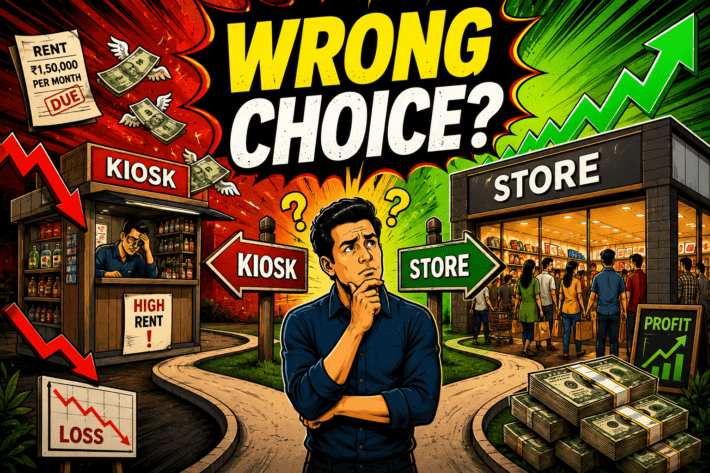
Kiosk vs Full Store ROI — Which Format Actually Makes More Money in India?
A small-looking business is not always a cheap one. Study the real numbers before you decide.
Picture this — you are standing in the atrium of a large mall.
You think: “If I open a small, attractive kiosk here, the entire mall crowd will walk straight to me. Rent will be lower. Risk will be lower.”
Then, two months in, reality hits. Mall management is constantly breathing down your neck. There is nowhere to store stock. Your staff has been standing for 10 hours straight. And that kiosk you thought was “small and affordable”? It is costing you more per square foot than a full store would have.
A small-looking business is not always a cheap one — and that is the real kiosk vs full store ROI story that nobody tells you upfront.I am Gulshan Mishra — and in 16 years of working with franchise investors across India, I have seen this one mistake repeated endlessly: choosing a format based on emotion, not calculation. Today we are going straight to the numbers — the real truth about kiosk vs full store ROI.
Because in business, emotion alone will not pay your rent. The investor who calculates before committing always outlasts the one who commits before calculating.
Chapter 01 — The Low Rent Illusion Kiosk vs Full Store ROI: The “Budget Format” Myth That Costs Investors Dearly
The first and most common mistake — investors assume that Kiosk = Budget Business.
On the surface, this seems logical. Lower setup cost, less space, fewer staff. But the moment you calculate rent per square foot, the picture flips completely.
- 📐Full Store Rent: On a high street, the average is ₹150–250 per sq. ft. per month. A 300 sq. ft. store costs ₹45,000–75,000 per month in rent.
- 📐Mall Kiosk Rent: Mall “Common Area” is premium real estate. Expect ₹500–₹800 per sq. ft. per month. An 80 sq. ft. kiosk costs ₹40,000–64,000 per month — for a fraction of the space.
- 📐The Shocking Math: You are paying nearly the same rent for 3–4 times less space. Your revenue capacity is a fraction — but your cost is almost identical.
Indian Customer Psychology — The Sitting Space Factor
There is one more reality that never appears in any brochure: the Indian customer wants to sit comfortably before spending money.
A kiosk offers no seating. If your product requires a customer to try, consider, or experience it — clothing, food, salon services — your kiosk will end up being nothing more than an expensive “display window” that generates curiosity but not conversions.
Ground Reality: A kiosk is only genuinely profitable when the product is a “Grab & Go” item. If a customer needs more than 2 minutes to make a decision — you need a full store, not a kiosk.
Chapter 02 — The Real Pain of Operations Kiosk Operations: Where Paper ROI and Real ROI Fall Apart
Now look at it from a second angle — Operations. This is where the gap between the projected kiosk vs full store ROI and ground reality becomes the most painful.
- 🔴No Storage Space: A full store has a back room for inventory. In a kiosk, your entire stock sits on open display in front of everyone. Restocking is needed every 2–3 days, which drives up logistics costs significantly.
- 🔴Constant Mall Management Interference: Every few days, a mall manager will show up — “Move that box,” “shift that display,” “this branding is not approved.” Your energy goes into compliance, not into running your business.
- 🔴Staff Exhaustion: Your team stands for 10 hours straight with no place to sit. Efficiency drops. Service quality deteriorates. Staff attrition rates at kiosk businesses run 40% higher than at full stores.
- 🔴No Washroom or Rest Area: Staff must use the mall’s common washroom — leaving the counter unattended every single time. A 10-minute absence means missed sales, every day.
- 🔴Higher Security Risk: Open-display stock is vulnerable to theft. Insurance premiums and shrinkage losses are consistently higher in kiosks than in enclosed full stores.
A kiosk’s ROI looks faster on paper because the initial investment is lower. But when you factor in maintenance, operating hassles, and limited revenue capacity, the net profit over 12 months is typically 20–30% lower than a comparable full store. This is the calculation no salesman ever runs for you.
Kiosk vs Full Store ROI — Real Numbers Side by Side
| Factor | 🏪 Kiosk | 🏬 Full Store |
|---|---|---|
| Setup Investment | ₹2–5 Lakh | ₹8–20 Lakh |
| Monthly Rent | ₹40,000–65,000 | ₹25,000–75,000 |
| Rent per Sq. Ft. | ₹500–800/sq.ft. | ₹150–250/sq.ft. |
| Revenue Capacity | ₹1–2.5 Lakh/month | ₹3–10 Lakh/month |
| Net Margin (Avg) | 10–18% | 18–28% |
| Staff Efficiency | Low (no seating) | High (proper space) |
| Break-Even Timeline | 6–10 months | 10–18 months |
| Long-Term Stability | Low–Medium | Medium–High |
| Best For | Grab & Go products, 70%+ margin | Experience products, 20+ min dwell time |
Chapter 03 — The Decision Framework Kiosk vs Full Store ROI — The Margin vs Volume Rule
So what should you actually choose? Here is the simple, battle-tested framework I give every investor after 16 years in the field.
Case Study Deepak From Indore — How Kiosk vs Full Store ROI Led to the Right Decision
Same Budget, Two Formats — Completely Different Results
Deepak Sharma, 31, had left a private sector job in Indore and wanted to enter the franchise business. He had a budget of ₹10 Lakh. A popular quick-service food brand offered him two options — a mall kiosk for ₹7 Lakh all-in, or a high-street full store requiring ₹14 Lakh.
Deepak’s first instinct was to go with the kiosk — “Mall footfall is guaranteed and the investment is lower.” But a franchise consultant ran the 3X Rent Rule for him before he signed anything.
Kiosk calculation: Mall rent ₹52,000/month = ₹1,733/day. The 3X Rule requires minimum daily sales of ₹5,200. With an average ticket of ₹120, that means 44 transactions per day just to break even. Actual footfall conversion at that specific mall location? 18–22 transactions per day.
Full store calculation: High street rent ₹28,000/month = ₹933/day. 3X minimum = ₹2,800/day in sales. Same product, table seating available, dine-in possible — average of 55–65 daily transactions. Achievable by Month 3.
Deepak stretched his budget by ₹4 Lakh and took the full store. Month 5: break-even. Month 9: ₹38,000/month net profit. Two years later: ₹72,000/month — an estimated 3x better net outcome than the kiosk option would have delivered.
Due Diligence 5 Questions Every Investor Must Ask Before Choosing a Kiosk or Full Store
Find the answers to these 5 questions before deciding on a format — regardless of how much pressure a brand’s salesman applies.
-
✅“What is the actual daily footfall data at this location — and what is the conversion rate?” Request footfall data directly from mall management. High footfall does not automatically mean high conversion — especially for kiosk formats.
-
✅“What is the average customer dwell time for my specific product?” Under 2 minutes = consider a kiosk. Over 10 minutes = a full store is non-negotiable. This single question resolves 80% of the format decision.
-
✅“What are the mandatory branding, display, and renovation clauses in the kiosk or mall agreement?” Some mall agreements require forced refits during mall renovations — entirely at your cost. Know this hidden liability before you sign.
-
✅“Applying the 3X Rent Rule, how many daily transactions does my product’s average ticket require?” Is that number realistically achievable or just aspirational? Verify against existing similar outlets — not the brand’s projected figures.
-
✅“Which format have the brand’s most successful existing franchisees actually chosen?” The format that the majority of profitable franchisees use is the real signal. Trust the franchisee’s reality over the brand’s recommendation.
FAQ Kiosk vs Full Store ROI — Top 5 Questions Answered
Your Next Move Kiosk vs Full Store ROI — Gold Mine or Trap? The Honest Answer
A kiosk can be small — but its operational demands are surprisingly large. A full store can be bigger — but its long-term stability is far more dependable.
In 16 years of franchise consulting, the businesses I have seen consistently succeed are those that matched their format to their location and product — not those that simply chose the lower setup cost.
The real answer to kiosk vs full store ROI depends on your product category, margin structure, and your target customer’s dwell time — not just your budget. Run the Margin vs Volume Rule and the 3X Rent Rule before you commit to anything.
If you are unsure which format makes practical sense for your specific budget, product, and city — do not guess. Visit FranchiseZing.com and get the right guidance before you invest a single rupee.
🎯 Free Tool — Limited Access
💬 Comment “FRANCHISE” Below!
I will personally send you my Free Investment Assessment Report Tool — which will tell you, based on your location, budget, and product, whether a kiosk or a full store is the right move for you.
▶ Comment “FRANCHISE” on YouTube →📌 Just type “FRANCHISE” in the YouTube video comments — and I will personally reach out. See you in the next video! 🚀