
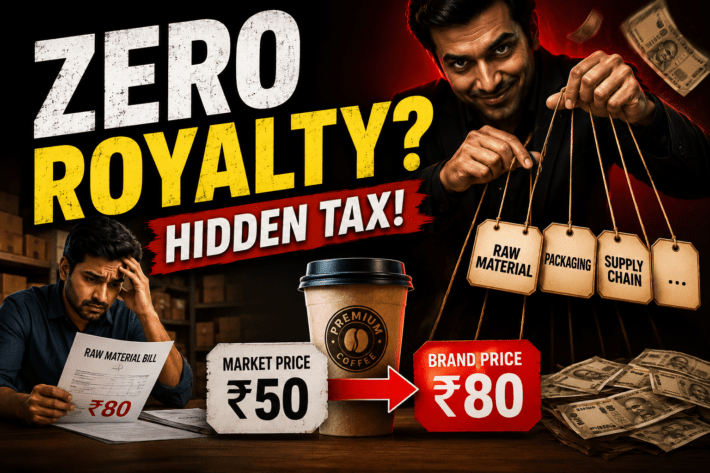
The Zero Royalty Franchise Trap — What India’s Brands Don’t Want You to Know
No royalty sounds like free money. But the supply chain margin is the hidden tax no one talks about.
Picture this — you are signing a franchise agreement and you are genuinely excited.
The brand has told you: “Zero Royalty.” You think — brilliant. Every rupee of profit stays in my pocket. No monthly cuts. No percentage going to the brand.
Then the end of month one arrives. You open the raw material invoice. That ingredient available in the open market for ₹50 per kg is being charged to you at ₹80 per kg — because the agreement says you can only buy from the brand’s approved vendor.
You are not paying royalty. But you are paying a hidden tax on every single order — and the brand is collecting it silently through the supply chain.I am Gulshan Mishra — and in 16 years of working with franchise investors across India, I have seen this trap destroy more businesses than almost any other. The zero royalty franchise pitch is one of the most effective marketing tools in the Indian franchise industry — and one of the most misunderstood.
Today we are going to expose exactly how the zero royalty franchise model works, where the money actually flows, and the three rules that will protect you before you sign anything.
Chapter 01 — The “Free” Marketing Trap Why “Zero Royalty Franchise” Is the Most Seductive — and Dangerous — Phrase in India
In the Indian market, the word “Free” is the most powerful sales trigger in existence. When a brand says “Zero Royalty,” our brain immediately registers: “This brand is generous. I get to keep everything.”
But there is one iron rule of business that never changes: no brand is running a charity. If a brand is not collecting royalty openly, it is collecting its margin somewhere else — and that somewhere else is almost always the supply chain.
How Zero Royalty Franchise Models Hide Their Profit in India
- →Mandatory Vendor Lock-In: The franchise agreement requires you to purchase all raw materials, packaging, and consumables exclusively from the brand’s approved vendors. You have no choice — it is written in the contract.
- →Inflated Procurement Prices: Those “approved” vendors supply at a price 20–40% above open market rate. The brand earns a margin from every batch of masala, every box of packaging, every litre of base ingredient you order.
- →Volume Amplification: Unlike royalty (which is a % of your revenue), supply chain margin hits you on every unit of raw material — regardless of whether you are profitable or not. The more you sell, the more raw material you buy, the more the brand earns.
- →Zero Alignment of Interests: With a royalty model, the brand wants you to sell more because they earn more. With a zero royalty supply model, the brand has already earned when they shipped you the stock. Your sales performance is no longer their concern.
Chapter 02 — Quality Control or Profit Control? The Zero Royalty Franchise Brand’s Real Incentive — And Why It Hurts You
Now look at this from a second angle — whose interests does a zero royalty franchise model actually serve?
In a zero royalty supply chain model, the brand’s profit is locked in the moment they ship you the raw material. Whether your outlet has a great month or a terrible month — the brand has already collected its margin.
- 🔴Training Support Drops Off: When your sales fall in a zero royalty model, the brand has no financial incentive to help you recover. They are not losing royalty income — they already collected their supply margin. Why would they spend money on your training?
- 🔴Marketing Support Is Minimal: A royalty-based brand invests in your local marketing because it directly improves their income. A supply-chain-based brand has no such incentive. The marketing support you were promised in the pitch meeting quietly disappears after you open.
- 🔴No Skin in Your Game: When a genuinely aligned brand sees your outlet struggling, it hurts their revenue. They will intervene. In a zero royalty supply model, your struggle is commercially invisible to the brand as long as you keep placing stock orders.
⚡ The Real Numbers Behind Zero Royalty Franchise India
A typical food franchise with 5% royalty on ₹3 Lakh monthly sales = ₹15,000/month to the brand. The same brand with zero royalty but raw material at 30% above market rate on ₹1.5 Lakh of monthly stock purchases = ₹45,000/month to the brand — silently. Zero royalty just cost you three times more.
Chapter 03 — The Net Margin Framework 3 Rules to Protect Yourself From the Zero Royalty Franchise Trap in India
The good news: this trap is entirely avoidable — if you know what to look for before you sign. Here are the three rules I give every investor who comes to me evaluating a zero royalty franchise model.
Always read the Product Procurement Clause of any franchise agreement carefully. Two questions to answer before signing: (1) Am I allowed to source from local vendors if I match the quality specification? (2) Is the approved vendor price locked in the agreement — or can the brand raise it at any time? If the answer to question 2 is “not locked” — your cost structure is entirely at the brand’s discretion.
Zero Royalty vs Standard Royalty — Real Cost Comparison at ₹3 Lakh Monthly Sales
| Cost Factor | 🚨 Zero Royalty Model | ✅ Standard 5% Royalty Model |
|---|---|---|
| Monthly Royalty | ₹0 | ₹15,000 |
| Raw Material Cost (Market Rate) | ₹90,000 (30% of sales) | ₹90,000 (30% of sales) |
| Brand Vendor Premium (avg 30%) | +₹27,000 hidden cost | ₹0 (open sourcing allowed) |
| Marketing Support from Brand | Minimal / None | Active (brand’s income tied to yours) |
| Training & Recovery Support | Low post-launch | Ongoing (brand wants your sales up) |
| Total Actual Brand Income | ₹27,000+ (hidden) | ₹15,000 (transparent) |
| Net Impact on Investor | Pays MORE — invisibly | Pays LESS — with full support |
Ground Reality: In most zero royalty franchise models in India, the effective “hidden royalty” through supply chain premiums works out to 8–15% of monthly revenue — significantly more than a standard 5% royalty — with none of the brand support that a royalty model incentivises.
Case Study Vikram From Patna — The ₹12 Lakh Zero Royalty Franchise Lesson
He Chose “Zero Royalty” — And Paid Three Times More Than He Expected
Vikram Singh, 38, was a bank employee in Patna who had saved ₹12 Lakh over eight years. He wanted to invest in a food franchise as a second income. Two brands were on his shortlist — Brand A at 5% royalty with open sourcing, and Brand B with zero royalty but mandatory vendor procurement.
Brand B’s salesman was persuasive: “Zero royalty means zero deductions. Every rupee of profit is yours.” Vikram chose Brand B and invested ₹11 Lakh. He was excited. The numbers on paper looked exceptional.
Month one opened his eyes. His masala base — available locally for ₹60/kg — was being charged at ₹95/kg through the brand’s vendor. Packaging boxes: ₹4.50 each from the brand, ₹2.80 from the local market. The agreement had a clause: “All procurement must be sourced exclusively from brand-approved vendors.”
Vikram’s raw material cost settled at 43% of his monthly revenue — well above the 35% danger threshold. His net margin collapsed to 7%. Monthly profit: ₹14,000 on ₹2 Lakh in sales — barely enough to justify the investment.
When sales dipped in Month 4, he contacted the brand for marketing support. The response: “We do not currently have a local marketing programme for your city.” Brand B had already collected its margin through the supply chain. Vikram’s success was no longer their concern.
Due Diligence 5 Non-Negotiable Questions Before Signing Any Zero Royalty Franchise Agreement
These questions must be answered in writing — not verbally, not in a pitch presentation, but in the actual agreement or a signed addendum.
-
✅“What is the approved vendor’s price list — and is it locked in the agreement for the duration of the contract?” If prices are not locked, the brand can raise raw material costs at any time and your entire cost structure changes overnight.
-
✅“Can I source from an alternative vendor if I can demonstrate equivalent quality?” A genuine quality-control argument is valid. A blanket “no alternatives” policy with no quality benchmark is a supply chain profit mechanism — not a quality standard.
-
✅“What is the current raw material cost as a percentage of revenue at your best-performing franchise outlet?” If the brand cannot answer this or deflects the question — that itself is your answer.
-
✅“What specific marketing and training support does the brand provide after launch — and is it written into the agreement?” Verbal promises mean nothing. If post-launch support is not contractually committed, assume it will not materialise.
-
✅“Can I speak directly with three existing franchisees about their actual raw material costs and net margins?” The franchisees who have been operating for 12+ months will tell you the truth that the sales pitch will not. If the brand refuses this request — walk away immediately.
FAQ Zero Royalty Franchise India — Top 5 Questions Answered Honestly
Your Next Move Zero Royalty Franchise India — Gold Mine or the Costliest Trap?
In business, nothing is truly free. Either you pay royalty openly — or you pay supply chain margin silently. My 16 years of experience distil into one sentence: always choose the brand that is transparent, even if it charges royalty.
A zero royalty franchise can be a genuine opportunity — but only when the approved vendor prices are fair, the procurement clause allows quality-matched alternatives, and the brand’s post-launch support is contractually committed. Without these three conditions, zero royalty is simply a better-sounding name for a higher-cost model.
Run the Price Check. Apply the 35% Bar. Model the Fixed vs Variable impact at scale. And before you sign anything, visit FranchiseZing.com — because the right guidance before you invest is always cheaper than the wrong investment after you sign.
🎯 Free Tool — Limited Access
💬 Comment “FRANCHISE” Below!
I will personally send you my Free Investment Assessment Report Tool — which will expose the hidden supply chain margins in any zero royalty franchise model you are evaluating and give you a clear total cost of ownership picture.
▶ Comment “FRANCHISE” on YouTube →📌 Just type “FRANCHISE” in the YouTube video comments — and I will personally reach out. See you in the next video! 🚀